|
Today, I'm thinking about the thing that can make the most difference decades after we're gone.
When I talk with people who've worked hard and saved well, the most fulfilled have one thing in common. They see their wealth as a responsibility to help others.
And somewhere along the way, that responsibility turned into one of the greatest joys of their lives.
They give to their community, to the organizations they care about, to the people working on some of the world's biggest problems.
And they put real money behind it.
So in this fourth email of our Die with Zero series, let's talk about charitable giving, and why, when done right, it may be the best return your money ever earns.
Bill Perkins's take on charity is probably the most direct of all his teachings. His argument for giving comes down to one line, and it's stuck with me ever since I first heard it.
"If you have charitable [causes] or other people that you want to give money to, then give it to them now. Life is urgent. Life is now."
Life is urgent.
Life is now.
Most of us plan like we have all the time in the world. We don't.
He doesn't stop there, either. He says, "If you give generously when you're alive, then I can consider you selfless. If you're dead, you just don't have that choice. So by definition, you cannot be generous when you're dead.”
Almost every client we sit down with already has a cause they care about. They just don’t know where to start when it comes to giving. They aren’t alone.
A recent Fidelity study found that nearly 8 in 10 people say charitable giving matters to them. Yet only about half of retirees have ever discussed it with their advisor.
That's not entirely on them, though. Most advisors never bring it up. For many, it isn't a focus, few are trained in it, and money given away is money leaving the accounts they manage.
At Streamline, charitable giving is one of our favorite conversations to have. We've helped more than 100 families give away about $20 million to the causes they care about. Here are some of the organizations we've helped.
You can give with your dollar or your time, and both make a real difference. Let's start with your dollar, and two of the best ways to give while working with the IRS:
- A Qualified Charitable Distribution (QCD), which lets you give directly from an IRA to a charity, tax-free, once you're 70½.
- A Donor-Advised Fund (DAF), which works more like a charitable savings account. You contribute now, get the tax benefit now, and decide which causes to support over time.
Every situation is different, which is why these tools deserve a conversation. If this isn't something your current advisor specializes in, or it just doesn't feel like the right fit to bring up with them, we'd love to help. Let’s talk through your goals.
The way I see it, dying with zero means getting to the end of your life knowing you gave everything you could, both your money and your time, to the things that made your life full.
Ask anyone who runs a nonprofit what they're actually short on, and money is rarely the first answer.
What they need are people who show up.
Once you retire, your calendar finally belongs to you, and I'll be honest, some of the best ways to spend that newfound time aren't about you at all. You could:
- Teach a skill you’ve spent forty years mastering.
- Show up for a weekly shift at the food bank.
- Sit with someone in hospice who has no one else coming.
- Start your own nonprofit.
- Mentor young entrepreneurs.
The act will look different depending on the cause or organization, but the impact you have on your community is the same.
Nelson Mandela said, "What counts in life is not the mere fact that we have lived. It is what difference we have made to the lives of others that will determine the significance of the life we lead."
Today, I want to encourage you to ask yourself,
Is there a cause I’d genuinely regret not giving more of myself to?
When something comes to mind, write it down, and think of one specific way you could show up in the next month for that cause.
That might be a generous donation sent by check, or maybe it's a phone call to ask how you can help.
Everyone’s form of giving looks different, but what matters is how it fills your cup. That’s the best return your money can earn. It’s the young man you mentored who finally landed the job you helped him prepare for. It’s the scholarship letter with your name on it that changed the course of a kid's life.
It’s the feeling of knowing you made a real difference that will stay with you for years.
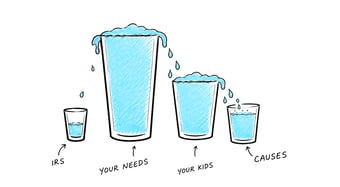
We've now covered three of the four places your retirement overflow can go. One more to go, and this fourth and final place is different.
It comes back to you.
In the next email, we'll talk about pouring some of that overflow back into your own cup.
Talk soon,
Tim

Tim Meisenheimer, CFP®, CFA
CEO, Streamline Financial
P.S. This poem puts into words what I hope for every family I work with. I’d love to leave it here with you today.
"When Earth's last picture is painted,
And the tubes are twisted and dried,
When the oldest colors have faded,
And the youngest critic has died,
We shall rest, and, faith, we shall need it,
Lie down for an aeon or two,
Till the Master of All Good Workmen
Shall put us to work anew…
And no one shall work for money,
And no one shall work for fame,
But each for the joy of the working,
And each, in his separate star,
Shall draw the Thing as he sees It
For the God of Things as They are!"
— Rudyard Kipling, “When Earth's Last Picture Is Painted”
|
