|
There’s one question I hear more than almost any other: "How much of what I’ve built is the IRS going to take?"
It’s a fair question to ask. No one chooses to send their overflow (the money left over once their retirement needs are covered) to the IRS. But without a plan, that's exactly where it heads first.
It usually happens when we go with the flow. Without a plan, your money drifts toward the default, and the default favors the IRS.
In this second email of our Die with Zero series, I want to change how you think about taxes.
The goal is simple. Every dollar you keep from the IRS is a dollar you can give to your kids, the causes you care about, or back into your own lifestyle. And here's what surprises people most when they talk with us:
You don't have to fight the IRS.
You can actually work with it.
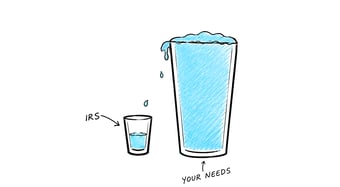
The tax code is packed with opportunities to keep more of what's yours. You just have to know where to look.
Let me show you what I mean by looking at two couples who came to us wanting the same thing, but got very different results.
Couple A came to us early. They had a dream to buy a boat and sail the Great Loop, down the Mississippi, through the Gulf, and up the East Coast. Because they gave us time, we had room to plan. We spread their withdrawals across two tax years, keeping them out of a higher tax bracket, and the savings added up fast. That money went straight back into their pocket and toward the trip instead of the IRS.
They've got the boat, and they're mapping out the trip now. With the extra room in their plan, they're excited, confident, and counting down the days till they set sail.
Couple B called us from the RV dealership. "We found the one! We just need the money by Friday. Then it’s on the road to California!" But by then, their window to maximize their savings had already closed. There was no time to spread withdrawals, no room to plan around the brackets, and no way to cushion the landing.
They got the RV. But their plan feels tight now, and every next step comes with a little more worry about what they can afford.
Same dream. Different endings.
It all comes down to three things: intentional timing, deliberate planning, and strategic execution. Couple A didn’t cheat the system. They just came to us early, so more of their money ended up in the boat fund and less with the IRS.
Now, here's the good news:
None of this is reserved for people with a finance degree or a certain net worth. The same three moves that helped Couple A can work for you, starting today.
Step 1: Intentional timing. Name your intentions on paper.
What do you want your money to do while you're alive to enjoy it, and what will each choice cost you in taxes? The earlier you know, the more options you have.
Step 2: Deliberate planning. Bring those answers to your advisor and ask the question most people never think to: "How do I work with the IRS on this?"
Two of the simplest places to start are Roth conversions, which let you pay the tax now on your own timeline, and naming a charity as your IRA beneficiary, so your cause gets the full amount and your kids skip the tax bill. Worth an ask to see if either is right for your situation.
Step 3: Strategic execution. A plan only pays off once it's in motion. Bring big purchases into it early, time around the tax calendar, and revisit it each year as life changes.
As Perkins puts it, "To get the most out of your time and money, timing matters." The sooner you look at your own numbers, the more you can do with them, and that's exactly what our team loves to help with. Let's find some time to talk.
So, here's what I want you to take from this:
The people who paid the IRS more than they needed to rarely made a bad decision. They just made the decision too late.
And right now, you're doing the one thing that turns a scramble into a plan: thinking about it on your own terms before circumstances decide for you.
Now that you know how to keep more of your overflow, it's time for the fun part. Next, we'll look at the people who probably came to mind first when you pictured where it could go.
More soon,
Tim

Tim Meisenheimer, CFP®, CFA
CEO, Streamline Financial
P.S. With my oldest just starting college, I've been thinking more and more about what I want to set up for my own family after I’m gone. I keep coming back to a line from David Green, the founder & CEO of Hobby Lobby. He says,
Legacy isn't what you leave behind, it's what you set in motion.
Isn’t that what it’s all about? Not the taxes you save, but the life you keep moving forward, long after you've stopped steering it yourself.
|
