.png)
|
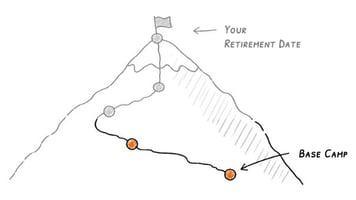
It’s Day 2 of the journey to reach your retirement summit. Quick recap in case you missed it: I’ll be sending you one question a day this week, working through the most important questions to ask as your retirement date approaches.
Yesterday was about picturing your day-to-day.
Today, we're looking at money, which is what most people lose sleep over. But remember, money is still just one part of the climb to fulfillment.
|
 |
|
Plenty of people feel uncertain about their account balances when planning for retirement, but here's the good news: A recent review conducted by the Center for Retirement Research at Boston College revealed that even with money worries and the usual regrets about not saving enough, 92% of retirees say they're actually happy with their lives.
Financial habits matter, but they're rarely the whole story behind whether someone actually feels good about where they landed.
Money is a tool in your tool belt to have a meaningful life. My friend, Brian Portnoy, in his book “The Geometry of Wealth” calls this “funded contentment.” —
Before we jump into Day 2's question, take a moment to reflect on the following:
Most people have both answers ready pretty quickly. The interesting part is usually why.
What made your good financial habit stick, and what got in the way of the other one?
Write down both habits -- the one you're proud of and the one you'd change. Feel proud of your accomplishment, then take one concrete step today toward the habit you'd change.
Review your allocation, do 10 minutes of research on a strategy you've been putting off, or just have the conversation with yourself about what's been holding you back.
The goal is to start shifting now towards your ideal retirement. You might not close the gap, but I always say “progress over perfection.”
|
 |
 |
|
Tim Meisenheimer, CFP®, CFA |
|
P.S. Speaking of habits that get in the way…
Over the years, we've talked to many people who feel like they need to change their financial advisor, and somewhere in there is a hang-up. Often times, they stay with their current advisor for emotional or relational reasons, rather than what's best for them.
Now, both of those are very valid reasons. But it leaves you wondering, "Is this the right person to lead me through this transition?" with no clear direction on what to do next.
Changing your advisor is easier than you'd think, and no, it's not unkind to change. It's usually less complicated than it feels. Remember, you've paid for their guidance along the way. By changing advisors, you're not hurting them; you are prioritizing yourself, because you matter.
Let us know if you have any questions about what changing an advisor looks like, or if you'd like to see any of our email templates you can use to send to your current advisor, and we'll send those over. |